
The visual storytelling production classes that I teach typically begin with a foundational review of technical and creative concepts followed by practical application of the techniques, which after some practice, trial and (an occasional error or two) culminate with a final project.
There are three main parts to the equation that learning takes place:
1. The “process” in which students apply technical practices that were previously discovered;
2. The “product” that is the culmination of the desired project learning objectives by using the techniques; and
3. The “dissemination” with feedback, that happens during class critiques and evaluations from me. However, I have found that the subject and format of the project have a significant impact on the student’s overall experience and takeaways.
This past semester I had two classes that had unique, and I would argue, successful outcomes that both involved collaborations with outside partners. One was with my Field Production class that students were partnered with Sociology Capstone students to create a series of informational videos to promote the program and research. The other was my Advanced Field Production class who worked with a “real” band to produce a music video that was used to hype up their new song and album.
Both projects began with introductions to the subject matter by the “expert” collaborators, the Sociology Professor and guitarist of the band (who also happens to be a broadcast professional) to help the students get a feel for the content that they would base their projects on.
The Sociology Capstone students were randomly assigned to my Field Production students to participate in “pre-interviews” which is a documentary storytelling technique that I learned from professional documentarians. I have used this technique in my own creative documentary research projects that is designed to get a sense of the story as well as create a rapport with the subjects to establish a sense of trust that is helpful to capture honest testimonials.
Students in both classes created visual treatments with mood boards and production schedules that they presented in class to the collaborators, who, in return, gave reactions and responses to the students with suggestions that provided the experience of “working with a client,” but within an academic setting that offered alternative professional feedback that reinforced the class project content.
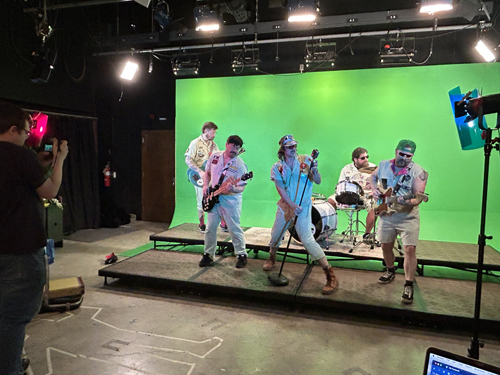
Photo by Erik Johnson
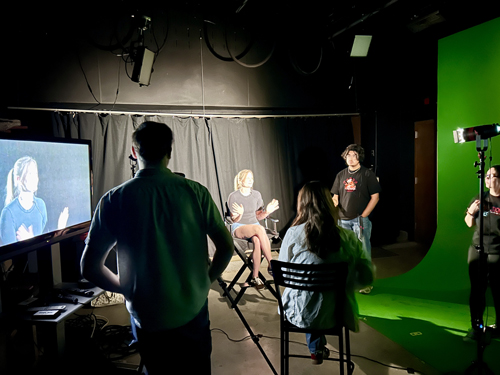
Photo by Erik Johnson
Here are quotes from the collaborators that give a glimpse into the experience from their perspectives:
“Working with Professor Johnson and his students gave my research capstone class a rare and meaningful opportunity to discuss their work in a professional context; exactly the kind of bridge-building across disciplines that is difficult to replicate through classroom assignments alone.” – Dr. Paige Miller, Professor of Sociology.
“We had a great time working with the Erik and his students and we feel the band got a high quality, professional music video that has been well received by viewers and fans.” – Alex Bowes, “Unattractive Giant Monster” guitarist. Both projects were a success in that they provided valuable reciprocal experiences for all involved with “real world” collaborators!
Erik L. Johnson
Professor – University of Wisconsin-River Falls
WBA Education Committee


